
RO Watermaker Repair in Indonesia: Membranes, Pumps and Who to Call
Bali Yacht Concierge Service Editorial Desk 7 min read
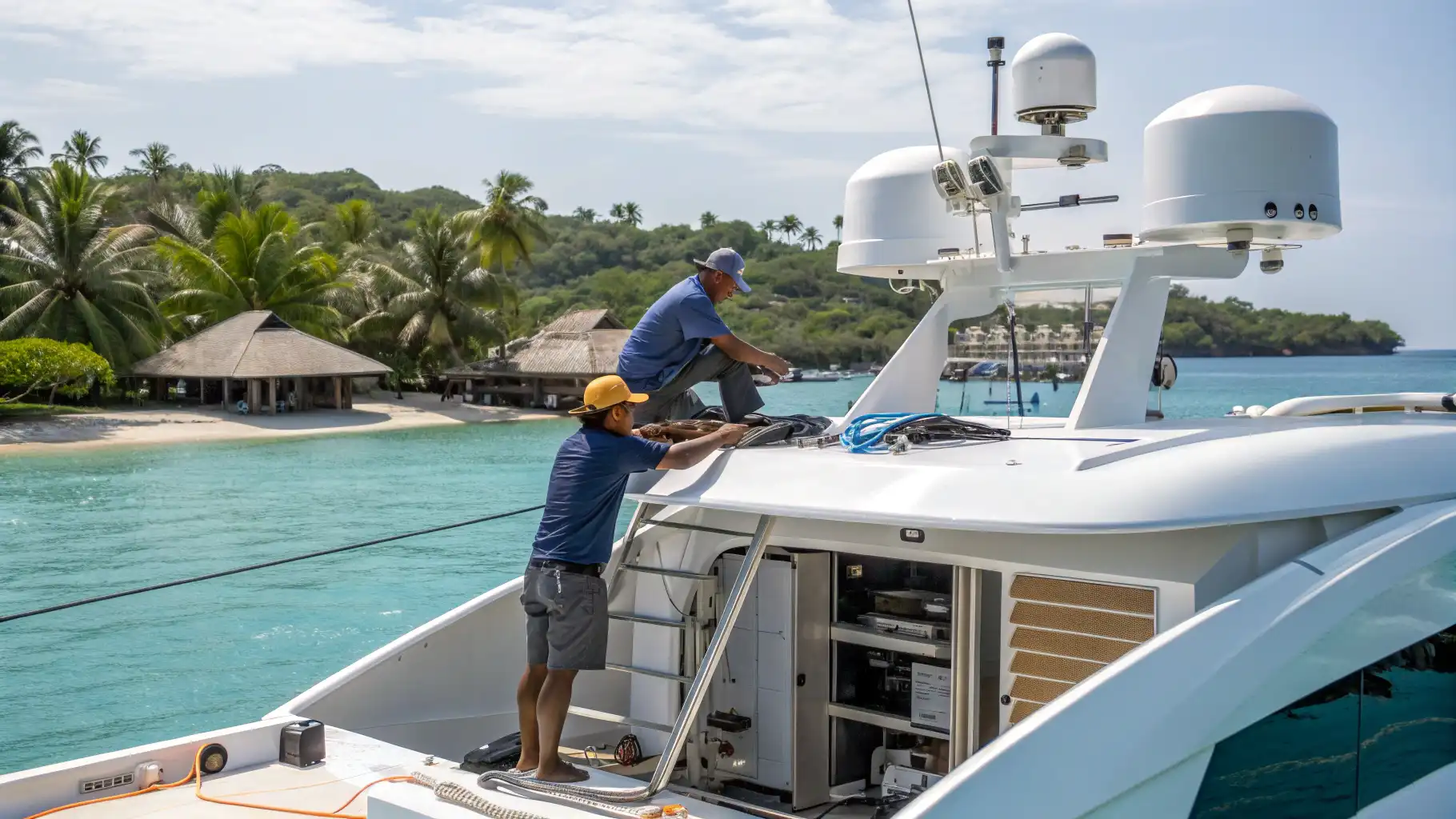
A yacht cruising Indonesia lives on its watermaker more than almost any system aboard: shore water is jerry-can water through most of the archipelago, and a failed reverse-osmosis plant turns a Komodo itinerary into a tank-management exercise. The good news is that most RO failures are diagnosable aboard and repairable in-country; the discipline is knowing which failure you have, what parts genuinely exist locally, and when to start the import clock.
Reading the Failure: Pressure, Flow, Quality
RO faults sort into three families. Low product flow with normal pressure points to fouled membranes or clogged pre-filtration — the low-cost family, usually solved with filters and cleaning cycles. Failure to reach operating pressure points at the high-pressure pump or its drive: worn seals and valves on plunger pumps, or the energy-recovery internals on modern low-power units — the mechanical family, repairable with kits if the kits exist aboard. Normal pressure but poor product quality — salinity creeping up, TDS readings the crew stops mentioning — points to membrane end-of-life or O-ring bypass in the vessels: the expensive family, because it usually ends in replacement elements. An hour with gauges, a TDS meter and the logbook narrows the family before anyone orders anything, and that hour is exactly what a remote diagnostic call with our technical desk covers.
The Membrane Reality
Standard-format membranes — the common 2.5-inch elements in 21- and 40-inch lengths that most yacht plants use — are genuinely obtainable in Indonesia: the country runs a large land-based RO industry for hotels and industry, and Jakarta, Surabaya and Bali distributors stock mainstream elements. The caveats: verify the exact element specification against the plant’s manual rather than accepting ‘equivalent’, insist on sealed packaging with manufacture dates, and expect proprietary-format membranes — the vendor-specific cartridges some yacht brands use — to be import items on the courier clock. Pre-filters, by contrast, are a solved problem: standard sediment and carbon cartridges are everywhere, and carrying a season’s stock is inexpensive insurance.
Pumps, Seals and Bali’s Machine Trades
High-pressure pump work is where Bali’s workshop economy earns respect: seal and valve kits for the common plunger pumps can be flown in quickly, and the island’s machine shops — accustomed to dive-compressor and small-marine work — handle the fitting, pressure testing and the occasional shaft or ceramic plunger surprise. Energy-recovery units are more specialised: their internals travel as complete assemblies from the manufacturer, which puts them on the import timeline. Electrical faults — feed pumps, controllers, salinity probes — are the quiet third category, and the one where a good marine electrician saves a membrane being blamed for a sensor’s lie. Coordination, parts receiving and technician scheduling run through our technical support desk.
The Import Clock and How to Beat It
Parts that must fly — proprietary membranes, ERU assemblies, controller boards — arrive on Indonesia’s marine-parts import timeline: courier days plus clearance, with the process smoothest when documentation is right the first time. Two habits beat the clock. First, the pre-season audit: run the plant hard before the cruising season, read the trends, and order the season’s likely parts while the boat sits somewhere convenient. Second, the cruising spares kit our desk recommends per plant: pre-filters in bulk, pump seal kit, O-ring assortment for the pressure vessels, salinity probe, and — for remote itineraries — a standard-format spare membrane, because east of Bali the courier network thins as described in our Flores cruising notes.
Prevention: the Unofficial Repair Manual
Most Indonesian RO failures are biology and neglect, not engineering: tropical feed water is warm, rich and hard on membranes, so fresh-water flushing after every run, pickling before any lay-up, pre-filter changes on schedule rather than on collapse, and honest TDS logging catch the majority of failures while they are still the low-cost family. A plant treated this way crosses the archipelago without drama; a plant run to failure meets the import clock at anchor, three days from the nearest courier depot. The desk’s job is making sure that meeting never happens.
Water Discipline While the Plant Is Down
When the watermaker does fail mid-itinerary, the week is manageable with immediate rationing arithmetic. Tank soundings first, honestly taken; then the crew meeting that resets expectations — showers to navy standard, laundry deferred, the galley on one-pot thinking, saltwater washdowns for everything the sea can clean. A cruising party of eight runs comfortably on a fraction of its normal consumption once everyone knows the number and the number is posted. Rain squalls become supply events: awnings and deck fills catch genuinely useful volumes in the wet season. Village water exists along most coasts but arrives as jerry-can water of unknown history — treat it as tank ballast and drinking-bottle backup, filtered and dosed, never as the plan. Bottled water for drinking is universally available and belongs aboard in depth anyway. Run this discipline from the failure’s first hour and the repair timeline loses its menace; run the tanks blind for two days first and the same timeline becomes an evacuation schedule.
Frequently Asked Questions
Can RO watermaker membranes be sourced in Indonesia?
Standard-format elements — the common 2.5-inch sizes most yacht plants use — yes: Indonesia’s land-based RO industry keeps Jakarta, Surabaya and Bali distributors stocked. Verify exact specifications and sealed packaging. Proprietary vendor-specific cartridges are import items on the courier clock.
How do I diagnose a watermaker fault on board?
Sort it into a family: low product flow at normal pressure means fouled membranes or pre-filters; failure to reach pressure means high-pressure pump or energy-recovery internals; normal pressure with salty product means membrane end-of-life or O-ring bypass. Gauges, a TDS meter and the log narrow it in an hour.
Who repairs watermaker high-pressure pumps in Bali?
Bali’s marine-adjacent machine shops handle plunger-pump seal and valve work, fitting and pressure testing, with kits flown in quickly for common pumps. Energy-recovery assemblies travel from manufacturers as complete units. Diagnosis, parts receiving and technician scheduling coordinate through the technical desk.
What watermaker spares should a yacht carry for Indonesia?
Pre-filters in bulk, a pump seal kit, pressure-vessel O-ring assortment, a salinity probe and — for remote itineraries — a standard-format spare membrane. East of Bali the courier network thins, so the spares kit plus disciplined flushing and pickling is what keeps the plant out of trouble.
Keep reading
Port Services
Indonesia Cruising Permit Costs in 2027: What Agencies Actually Charge
A foreign yacht's cruising paperwork for Indonesia in 2027 costs far less in official fees than most quotes…
7 min read
Port Services
Burgess in Asia and the Bali Shore Desk: How Central Agents Work With Local Support
When a managed superyacht plans an Indonesian season, two layers of representation come into play. The central agent…
6 min read

Port Services
Clearing In via East Bali: Amed Formalities for Arriving Yachts
Every season a handful of yachts approach Bali from the east — out of Komodo, Lombok or the…
6 min read